Capital Gains Are the Wrong Scoreboard When Your Income Can Vanish
The invoices slow down in February, or a big client pays sixty days late, and the mortgage payment still comes out on the first of the month. Your home is worth more than when you bought it. The rental is worth more too. None of that equity pays this week's bills without a sale or a new loan, and both take time you don't have while your income is down.
If you've ever had a slow billing month while your mortgage payment stayed exactly the same, you know how little a strong balance sheet helps at two in the morning. When your earnings are unpredictable, the better way to judge a rental is by the cash it can reliably leave you when the business goes quiet. The profit you might make selling it is a separate question, and it shouldn't crowd out the first one.
A bigger sale profit may not protect your next payment
The usual playbook is to buy well, ride the appreciation, sell at a good moment and put the money to work elsewhere. For someone with a salary and a pension, that's sound. Gains are real, and timing does matter.
Some investors never sell at all. One explained the reasoning simply: holding means they're never stressed about mortgage payments. If their own income stopped, the tenants would keep paying the mortgage and maybe some other expenses, with a sale kept in reserve as the last resort. That's a choice of security over maximum return. For anyone whose income arrives in lumps, it deserves a hearing.
So what would that protection mean for you? It comes in two levels. A rental that covers its own mortgage, property taxes and insurance means you won't have to feed it from your pocket in a bad month. That helps. A rental that leaves a surplus after all of that is putting money toward your groceries and your own mortgage. Only the second level holds up your household, and plenty of rentals bought on the Island in recent years sit at the first level or below it.
A rental is a backstop only if the cash survives a bad month
Start with spendable cash, and ignore gross rent. Here's an illustrative example: rent of $2,200 a month, against a $1,500 mortgage payment, $250 in property taxes, $120 for insurance and $200 set aside for maintenance and vacancy. That leaves $130. Then hold back money for income tax. Only the interest portion of the mortgage is deductible, so the tax bill on rental profit can eat most of that $130, or more than all of it.
Next, test the rental against two problems at once. Picture a slow quarter in your business arriving alongside a vacant unit, a failed furnace or a renewal at a higher payment. The same local slowdown that hits your clients can hit your tenants. Borrowing against the property gets hardest exactly then. CMHC asks self-employed applicants for 24 consecutive months of financial statements, lenders typically credit only 50% to 80% of gross rental income, and you must qualify at the higher of your rate plus 2% or 5.25%. A refinance planned for the bad month may not be available in it.
Finally, compare holding with selling. If a property leaves you $130 in a good month and a loss in a bad one, the net sale proceeds applied to your home mortgage could lower your required payment by more than the rental ever left you. That lower bill keeps working through every slow season. Sometimes the sale builds the stronger floor.
The question worth asking is "What could this property reliably cover if my earnings fell?" rather than "How much could I sell it for?" Pull last year's rent deposits and every expense receipt, add a tax provision, and find the real monthly surplus. Property wealth and household security are two different things. The investment worth keeping is the one that turns the first into the second.



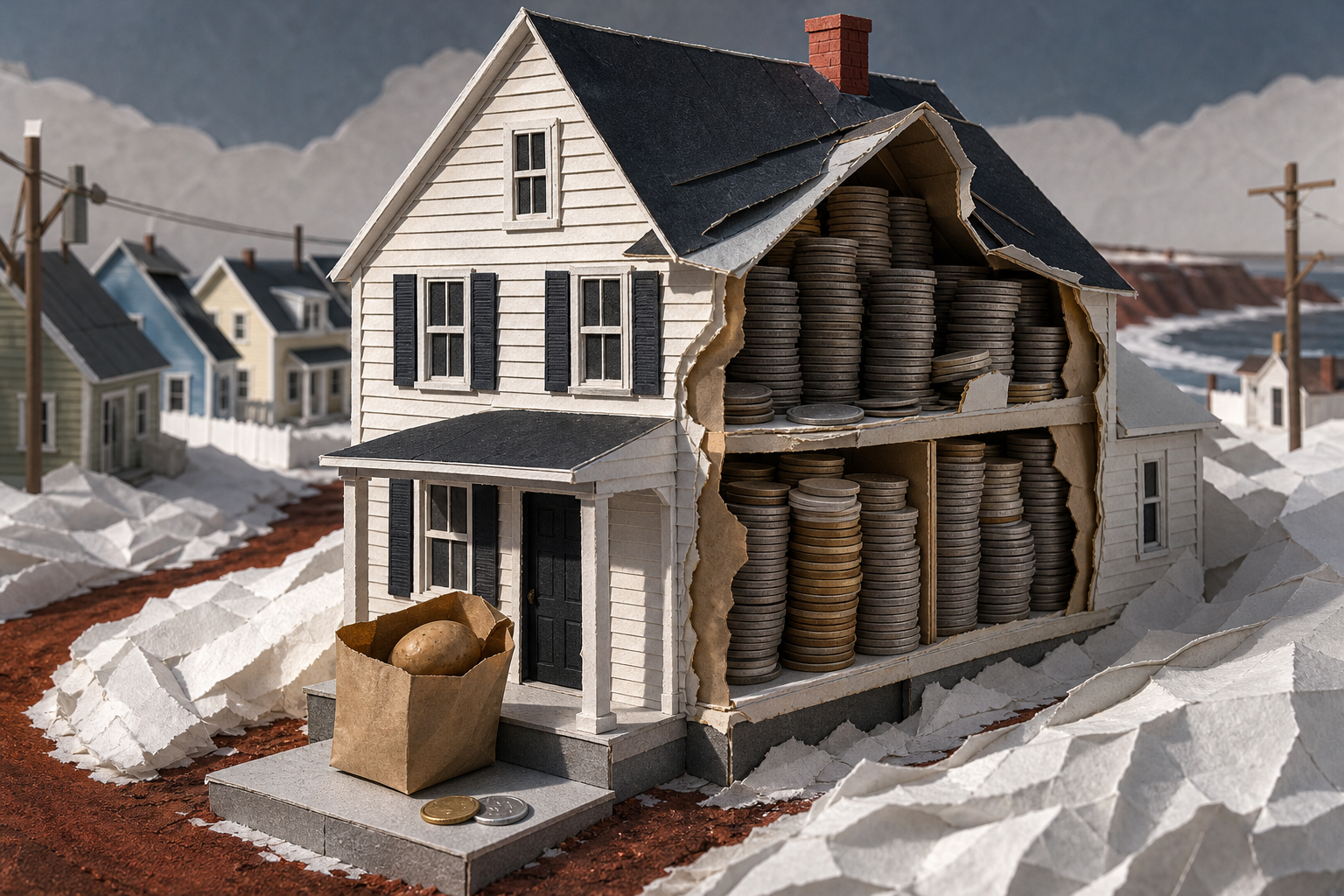

The invoices slow down in February, or a big client pays sixty days late, and the mortgage payment still comes out on the first of the month. Your home is worth more than when you bought it. The rental is worth more too. None of that equity pays this week's bills without a sale or a new loan, and both take time you don't have while your income is down.
If you've ever had a slow billing month while your mortgage payment stayed exactly the same, you know how little a strong balance sheet helps at two in the morning. When your earnings are unpredictable, the better way to judge a rental is by the cash it can reliably leave you when the business goes quiet. The profit you might make selling it is a separate question, and it shouldn't crowd out the first one.
A bigger sale profit may not protect your next payment
The usual playbook is to buy well, ride the appreciation, sell at a good moment and put the money to work elsewhere. For someone with a salary and a pension, that's sound. Gains are real, and timing does matter.
Some investors never sell at all. One explained the reasoning simply: holding means they're never stressed about mortgage payments. If their own income stopped, the tenants would keep paying the mortgage and maybe some other expenses, with a sale kept in reserve as the last resort. That's a choice of security over maximum return. For anyone whose income arrives in lumps, it deserves a hearing.
So what would that protection mean for you? It comes in two levels. A rental that covers its own mortgage, property taxes and insurance means you won't have to feed it from your pocket in a bad month. That helps. A rental that leaves a surplus after all of that is putting money toward your groceries and your own mortgage. Only the second level holds up your household, and plenty of rentals bought on the Island in recent years sit at the first level or below it.
A rental is a backstop only if the cash survives a bad month
Start with spendable cash, and ignore gross rent. Here's an illustrative example: rent of $2,200 a month, against a $1,500 mortgage payment, $250 in property taxes, $120 for insurance and $200 set aside for maintenance and vacancy. That leaves $130. Then hold back money for income tax. Only the interest portion of the mortgage is deductible, so the tax bill on rental profit can eat most of that $130, or more than all of it.
Next, test the rental against two problems at once. Picture a slow quarter in your business arriving alongside a vacant unit, a failed furnace or a renewal at a higher payment. The same local slowdown that hits your clients can hit your tenants. Borrowing against the property gets hardest exactly then. CMHC asks self-employed applicants for 24 consecutive months of financial statements, lenders typically credit only 50% to 80% of gross rental income, and you must qualify at the higher of your rate plus 2% or 5.25%. A refinance planned for the bad month may not be available in it.
Finally, compare holding with selling. If a property leaves you $130 in a good month and a loss in a bad one, the net sale proceeds applied to your home mortgage could lower your required payment by more than the rental ever left you. That lower bill keeps working through every slow season. Sometimes the sale builds the stronger floor.
The question worth asking is "What could this property reliably cover if my earnings fell?" rather than "How much could I sell it for?" Pull last year's rent deposits and every expense receipt, add a tax provision, and find the real monthly surplus. Property wealth and household security are two different things. The investment worth keeping is the one that turns the first into the second.
Read Next
Lump-Sum Inheritance or a Testamentary Trust? Here's Who Each One Is For
A $2,000 Storm Bill Is the Liquidity Test Most Canadians Are Failing
Your Paid-Off House Can't Pay the Grocery Bill in Retirement
If Your Slow Months Need a Credit Card, Your Good Months Aren't Good Enough